
by BSR Marketing | Mar 12, 2026 | Uncategorized
A note: Dan Reyes and his restaurant are fictional. This is an illustrative scenario built from patterns we see regularly in real Idaho kitchens. Not a profile of a real customer.
Dan Reyes had been running his 45-seat neighborhood spot for three years when his accountant said something that stopped him cold.
“Your revenue is growing,” she told him, sliding a printout across the table. “Your profit isn’t.”
He’d heard variations of this before and had always chalked it up to the cost of growing: more staff, more product, more everything. But this time he looked harder at the numbers. And what he found wasn’t in the revenue column or the labor column. It was hiding in the places he’d stopped looking: food waste, utility bills, overtime during close, and the slow bleed of a kitchen that was working harder than it needed to.
What followed was twelve months of deliberate, unglamorous investment. Not a renovation. Not new branding. Just a clear-eyed look at which pieces of equipment were costing him money every single day and what it would take to stop the bleeding.
Here’s what he found.
Investment 1: A Proper Walk-In Refrigeration Upgrade
Dan’s walk-in was original to the space: eight years old, never fully serviced, and quietly losing the battle against an Idaho summer. He knew the coils were dirty. He knew the door seal on the left side was soft. He’d been meaning to deal with it for two years.
What he hadn’t done was calculate what it was costing him.
When he finally pulled his produce waste numbers and cross-referenced them against his delivery schedule, the pattern was clear. A product that should have lasted four days was lasting two and a half. Herbs were wilting. Proteins were cycling through faster than they should. He’d been blaming his prep team. He should have been blaming his refrigeration.
A full walk-in service including new door gaskets, coil cleaning, thermostat calibration, and a compressor inspection was a fraction of what the neglect had been costing him. Within thirty days his produce waste had dropped measurably. Within ninety days he’d documented enough savings in wasted product alone to cover the service cost several times over. The energy savings from a properly running compressor were a bonus he hadn’t even factored in.
He thought he couldn’t afford to fix it. Turns out he couldn’t afford not to.
Investment 2: A Commercial Slicer Worth Using

Dan’s prep team had been using a slicer he’d picked up secondhand from a restaurant that had closed. It worked, in the sense that it sliced things. But the blade was dull, the thickness adjustment was unreliable, and his cooks had developed an unconscious workaround: cutting protein portions slightly thicker than spec to compensate for the inconsistency.
He didn’t notice it until a line cook mentioned it offhandedly during a staff meeting. “We go a little heavy on the slicer stuff because you never know what you’re going to get.”
He went back and looked at his portion cost data. On proteins alone, the informal over-portioning had been adding a few ounces per serving across dozens of covers a day. Multiplied across a year of service, the number was significant enough to make him wince.
A quality commercial slicer with a consistently sharp blade, reliable thickness calibration, and the kind of build that holds its settings under daily use paid for itself inside six months. His prep team also moved faster with less effort, which had a downstream effect on how they felt at the end of a long prep shift. That part didn’t show up in the spreadsheet, but Dan noticed it.
Investment 3: Walk-In Shelving That Actually Worked
This was the investment Dan had resisted longest, because the fix was so simple.
His walk-in shelving had been rearranged so many times over three years that it had become a kind of archaeological record of every operational decision he’d ever made and then changed. Shelves at the wrong heights. Product stacked directly against walls with no airflow. No consistent labeling system. His opening crew spent time every morning figuring out what they had before they could figure out what they needed to order.
He invested in a proper wire shelving system with adjustable heights, good airflow around produce, and enough organization to support a real FIFO rotation. He also had his team implement a labeling standard and stuck to it.
The immediate effect was a reduction in ordering errors. When you can see what you have, you don’t overbuy. When a product is rotating properly, you don’t find half a case of something in the back of the walk-in that expired while you were ordering more of it. Dan estimated his over-ordering dropped in the first month, not because he started ordering less, but because he stopped ordering things he already had.
The shelving investment was modest. The savings in over-ordering and spoilage were evident within weeks.
Investment 4: A Dishwasher That Closed on Time
Dan’s dishwasher wasn’t broken. It was just slow. And loud. And required a full cycle restart about twice a night when the sensors got finicky. His closing crew had built an extra forty-five minutes into their mental close time just to account for it.
He’d never thought of this as a money problem. It was an annoyance problem. But when his general manager pointed out that two closing staff members were consistently clocking out well past when they should have been, three to four nights a week, every week, the math changed quickly. Overtime at the end of a close shift adds up faster than most operators realize, especially when it’s invisible inside normal payroll variation.
He replaced the unit with a reliable door-type dishwasher that cycled consistently, cleaned thoroughly, and required exactly zero coddling from his closing team. Close times tightened immediately. Within three months the labor savings had covered a significant portion of the new machine’s cost. His closing crew, for the first time in two years, stopped dreading the end of service.
Investment 5: Energy-Efficient Cooking Equipment on the Line
This was the investment Dan had resisted longest, because it required replacing equipment that technically still worked. His range and his commercial fryer were both original to his opening: older units that ran hot, ran loud, and ran constantly, even during slow periods when he didn’t need them at full capacity.
His utility bills had always felt high, but utility costs are easy to normalize when you’re busy. It took an equipment supplier walking him through the energy consumption difference between his current range and a modern energy-efficient unit before the number landed properly. His older equipment was drawing significantly more power per hour than a newer equivalent, and he was running it twelve hours a day, six days a week.
He replaced the fryer first since it was the higher energy draw and the older of the two units. The new fryer also had better temperature recovery, which meant less oil degradation, longer oil life, and more consistent fry results during peak service. His oil costs dropped. His utility bill dropped. His fry quality improved. Three separate wins from one piece of equipment.
The range followed six months later. Between the two replacements, his monthly utility bill came down by enough to notice, and the consistency of cooking on a properly calibrated modern range had effects that rippled through food quality in ways that are harder to quantify but impossible to miss.
What Dan Learned (That Most Operators Learn Too Late)

By the end of the year, the documented savings across all five upgrades, reduced food waste, better portion consistency, lower over-ordering, labor savings at close, and lower utility costs added up to significantly more than the investment. That doesn’t count the harder-to-measure improvements: better food quality, a prep team that moved faster with less frustration, a closing crew that didn’t dread the end of service.
“The thing I keep coming back to,” he told a friend who was opening his first restaurant, “is that none of it was dramatic. It wasn’t a renovation. It wasn’t a new concept. It was just fixing the things that were quietly draining money every single day, and I’d been walking past all of them for three years.”
The best equipment investments aren’t always the flashiest ones. Sometimes they’re the refrigerators that hold temperature properly. The slicer that cuts consistently. The dishwasher that closes on time. The shelving system that lets your team see what they actually have.
The money was always there. It was just going to the wrong place.
Find Your Hidden Savings.
At BSR Design and Supply, we help operators find the equipment upgrades that actually move the needle, not the flashiest purchases, but the ones that pay for themselves. Stop by one of our showrooms or give us a call. Sometimes all it takes is a conversation to find where the money is going.

by BSR Marketing | Feb 25, 2026 | Uncategorized
Winter comfort menus have served Idaho diners well through the cold months; hearty soups, braised proteins, and root vegetable sides are always crowd pleasers. But as daylight stretches and farms begin their spring harvest, savvy restaurant owners and operators are already shifting gears. The transition from a winter to a spring menu isn’t just about swapping out dishes; it requires a thoughtful look at your kitchen equipment, storage systems, and prep workflow to make sure everything is ready for lighter, faster, fresher cuisine.
It’s time to start thinking about the spring now. Here’s how to get ahead of the season before it hits.
Let the Braise Rest. Spring Wants a Different Technique.

Winter cooking is about time and heat, long braises, slow roasts, and deep caramelization. Spring cooking is about precision and restraint. The flavors are more delicate, which means the techniques have to be too.
Start phasing out the heavy braises and root vegetable medleys in favor of methods that let fresh ingredients speak for themselves: blanching tender greens to lock in color and texture, shaving raw vegetables on a mandoline to showcase their crispness, and poaching fish and proteins gently in aromatic broths that don’t overpower.
These techniques ask more of your equipment. A mandoline or commercial slicer with a sharp, adjusted blade is essential for the kind of precision shaving that makes a radish or fennel salad shine. Your burners need to hold a consistent, gentle simmer for poaching; now is a good time to check for uneven flames from months of heavy winter cooking. And if you’re blanching in volume, make sure your stockpots and ice bath setup can handle the pace of a busy spring service without backing up the line.
People Eat with Their Eyes, and After a Grey Winter, They’re Starving for Color.
Idaho winters are beautiful, but they are not colorful. By now, your guests have been living in a world of grey skies, bare trees, and brown landscapes for months. When they sit down at your table in March or April, they are genuinely hungry for color. A spring menu is your opportunity to feed that hunger before they even take a bite.
Think about plate composition in the same way a photographer thinks about a shot. Spring produce, bright green peas, jewel-toned radishes, vivid orange and yellow citrus, and more give you a palette that winter simply doesn’t offer. Use it intentionally. A simple piece of halibut becomes a statement dish when it arrives on a smear of pea puree with a scattering of herbs and a few shaved vegetables catching the light.
Lighter textures go hand in hand with the visual shift. Heavy cream sauces that felt luxurious in January can feel oppressive in April. Replace them with citrus-based vinaigrettes and bright herb emulsions, preparations that add acidity and freshness instead of weight. This is also the chance to revisit your tabletop selection: lighter, brighter plate colors and shallower bowls tend to let spring food shine in a way that deep, dark winter glassware doesn’t.
For kitchens running more cold dishes (chilled salads, crudo, composed vegetable plates), a refrigerated prep table makes it dramatically easier to plate with precision and keep delicate ingredients at safe temperatures during service. The right cold storage conditions coming out of your walk-in matters as well: fresh herbs wilt fast if your walk-in isn’t dialed in, and a broken door seal or overworked evaporator coil can turn a beautiful spring delivery into a food waste problem in as little as 24 hours.
The Glass Matters Too: Refresh Your Beverage Program.

A spring menu overhaul that stops at the food is only half complete. Beverages are part of the sensory experience, and the same instinct that makes guests crave lighter food in spring applies to what’s in their glass.
On the wine side, shift toward crisp, high-acid whites. These wines complement spring’s freshness rather than competing with it, and they pair beautifully with the citrus-forward, herb-driven preparations that define the season. If you’ve been leaning on big reds and oaky chardonnays through the winter, this is the time to rotate the list.
For non-alcoholic options, spring is the golden season for creative mocktails. Cucumber and elderflower, rhubarb and ginger. Fresh citrus with herbs from your own prep station. Guests who don’t drink, or who are watching their consumption, are increasingly willing to pay for a thoughtfully made non-alcoholic beverage, and a spring mocktail menu signals that your restaurant takes the full experience seriously.
Put the Farmer on the Menu.
There’s one more thing that separates a good spring menu from a great one: knowing where the food comes from and telling your guests about it.
The Idaho region is full of extraordinary agricultural producers. When you source locally and feature those producers by name on your menu, something changes. Guests don’t just order a spring salad; they order a salad from a hardworking farmer that’s a part of their community.
This kind of storytelling builds loyalty and trust in a way that no marketing campaign can replicate, but it requires supply chain discipline on the back end. You’re working with smaller quantities, shorter shelf lives, and less predictable availability than you get from a large distributor. That means your cold storage needs to be tighter, your FIFO rotation more consistent, and your team trained to treat fresh local product with the respect it deserves. Walk-in shelving that’s properly organized and labeled, with airflow around your produce rather than boxes stacked directly against walls, is the unglamorous infrastructure that makes farm-to-table actually work.
The Season Won’t Wait, And Neither Should You.
Spring is not a trend; it’s not a marketing opportunity. It’s a genuine shift in what people want to eat, how they want to feel when they leave the restaurant, and what they’ll tell their friends about afterward. The chefs and operators who treat it that way, who approach the seasonal transition with the same seriousness they’d give a full menu rebuild, are the ones whose dining rooms fill up first when the weather turns.
The good news is that most of what it takes to do spring well isn’t complicated. It’s intentionality. It’s looking at your technique and asking whether it still serves the ingredient. It’s looking at your plate and asking whether it still earns someone’s attention. It’s looking at your menu and asking whether it tells the story of where your food actually comes from.
And it’s making sure your kitchen, your coolers, your slicers, your prep stations, and your shelving are set up to support all that, quietly and reliably, every single service.
Spring is coming to Idaho. Go meet it halfway.
Set Your Kitchen Up for the Season
At BSR Design & Supply, we carry the refrigeration units, prep tables, slicers, shelving, and smallwares that make spring menus possible; not just on paper, but on the plate. Stop by our showrooms or give us a call. Let’s make sure your kitchen is as ready for spring as your menu is.

by BSR Marketing | Feb 12, 2026 | Uncategorized
Dear Well-Run Restaurants, Impeccable Kitchens, and Every Foodservice Operation That Makes It Look Easy,
We need to tell you something: we see you.
We see you in the way a server glides through a packed Friday night dining room without a single wobble, carrying a tray of perfectly chilled martini glasses that catch the light just right. We see you in the kitchen, where every cook knows exactly where to reach for the right pan, the right spatula, and the right squeeze bottle, because everything has its place and nothing is ever missing.
We see you in the details most people never notice: the weight of a proper steak knife in the hand, the satisfying click of a well-fitted lid, and the way every plate that leaves your kitchen sits on a shelf that’s actually clean because you have enough backups to run them through the dish pit without panic.
You make magic happen, but here’s what we really love about you: your magic isn’t chaos. It’s not held together with duct tape and prayers. It’s not a chef screaming to “make it work” with mismatched pans and chipped plates.
Your magic is systems. Your magic is infrastructure. Your magic is beautiful, boring reliability.
You’re the restaurant where the bartender never has to frantically polish water spots off glassware mid-service because you invested in proper stemware that actually dries clean. You’re the kitchen where sauté pans heat evenly because someone made the decision to buy quality, not just whatever was cheapest. You’re the dining room where every fork matches, every water glass is the same height, and the entire experience feels intentional, because it is.
We love that you understand something fundamental: your creativity, your hospitality, and your culinary vision; none of it matters if the tools don’t work. A brilliant chef can’t execute with a poor design or warped sheet pans. A thoughtful server can’t create ambiance with a wobbly table set with mismatched glassware that looks like it was salvaged from a yard sale.

You know that the foundation of a great restaurant isn’t just recipes and reservation systems. It’s the small-batch ceramic plates that can withstand the rigors of a commercial dish machine. It’s the professional-grade mixing bowls that nest perfectly and don’t take up half your prep station. It’s the wine glasses that feel substantial enough to signal quality but aren’t so precious that you’re terrified to put them in regular rotation.
You understand that when your cook reaches for a cutting board, it shouldn’t slide around. When your dishwasher grabs a glass rack, it shouldn’t be cracked. When your server sets a table, the silverware should feel like it belongs in an adult’s hand, not a child’s playset.
This is what we admire most about you: you’ve done the unglamorous work. You’ve spec’d out your kitchen. You’ve thought about weight, durability, and replacement costs. You’ve made the call to invest in equipment, china, flatware, and glassware that won’t let you down on the night you get slammed, because you know that night is coming, and when it does, you need gear you can trust.
At BSR and SRE, we get it. We get you. We know you’re not looking for the cheapest option or the flashiest trend. You’re looking for the commercial-grade mixing bowls that will still be in service five years from now. The glassware that survives the reality of high-volume service. The tabletop items that make your vision actually visible to guests.
We know that behind every smooth service are bar tools that actually work, a shelf of sauté pans that heat evenly, and a dining room set with glassware that doesn’t look like it was borrowed from six different restaurants.
So here’s to you, restaurants that just work. Here’s to the kitchens where efficiency isn’t an accident but a choice. Here’s to every operator who understands that the best dining experiences are built on foundations most guests will never see: the right design, the right equipment, and the right tools.
You’re not just running a restaurant. You’re running a system. And that system deserves everything to work as hard as you do.
With deep respect and admiration,
BSR Design and Supply
by BSR Marketing | Jan 21, 2026 | Uncategorized
In our experience, when people talk about opening or renovating a restaurant, their minds automatically lock onto the big things: the concept, branding, menu, equipment… things like that.
Those things matter. A lot.
But there are some things on the ‘VIP’ (aka the ‘Very Important Pieces’) list that often get overlooked but make or break the effectiveness of a space and the experience the customer has.
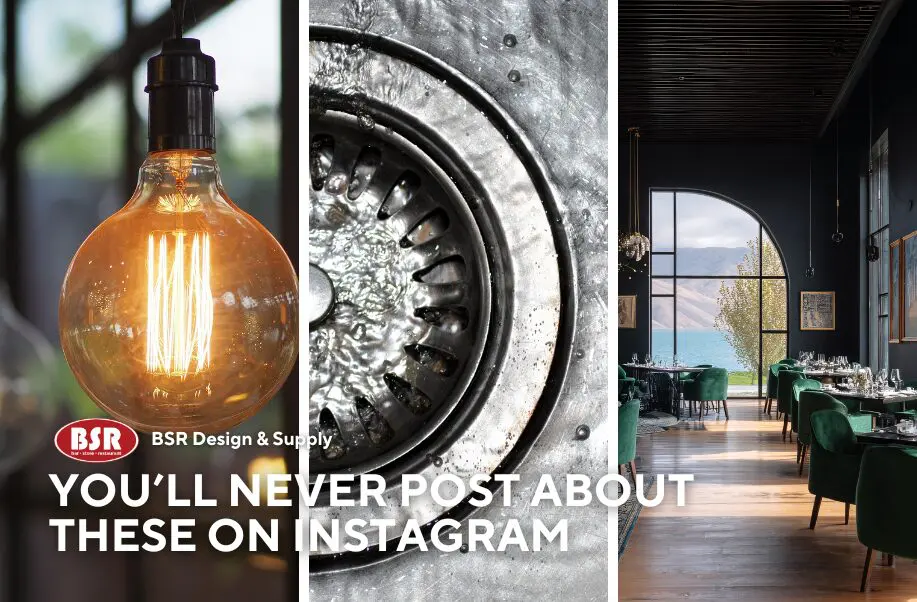
It’s the things that don’t end up on a restaurant’s Instagram feed that can determine whether a restaurant runs smoothly… or struggles every shift.
Some of the most important decisions are the ones no one talks about; here are a few of them:
Lighting That Supports Service, Not Just Style

Lighting isn’t just about setting the mood; it’s also about function.
Have a light that’s too bright? Guests might feel like they’re in a cafeteria. But if they’re dimmed too much, servers have to squint to see tickets, and guests can’t read the menu. Not only that, but the wrong placement can create shadows across plates, making food look unappealing, or a glare that’s uncomfortable during a long meal.
Try thinking of lighting in layers: ambient, task, and accent. Look at lighting as an operational and experiential tool. Ask yourself, is there enough lighting in prep areas? Does the dining area feel warm without feeling too dim?
When lighting is done right? Nobody comments on it; it blends into the experience.
Drainage: Not Glamorous, but Essential
It’s highly unlikely that drainage made it onto your restaurant’s Pinterest or vision board, but it can make or break the flow of a kitchen.
Improper angles, poor placement, or hard-to-access drains can lead to standing water, safety hazards, sanitation issues, and expensive maintenance down the line. Flooring materials matter just as much: slip resistance, durability, cleanability, and how they perform during long, high-volume shifts.
Think of them as part of the pit crew for the kitchen. They’re not necessarily glamorous, but they’re critical for protecting staff, meeting health codes, and keeping kitchens running efficiently.
Clearance and Circulation
Ever tried on a piece of clothing that you loved but was too small so you couldn’t move? It’s likely that you put it back because it wasn’t functional. Think of your kitchen layout in the same way.
A layout may be beautiful, but it means nothing if your staff can’t move and it’s not functional.
It’s important to carefully plan aisle widths, service path locations, and clearances around equipment, prep areas, and seating. Just a few inches of space can help determine the stress level of a shift.
For guests, good circulation means they’re not constantly bumped by servers or navigating awkward bottlenecks on the way to the restroom. For staff, it means fewer collisions, faster service, and less fatigue.
Flow matters more than people realize.
Tabletop Setups That Shape the Experience
Have you ever been at a restaurant and you’re struggling to find space for everyone’s plates? That could be because tabletop was neglected in the planning process. Tabletop design might feel simple, but it’s one of the most tactile parts of the guest experience.
Table height, chair comfort, how much space is between plate settings, and even the shape of the table all change how long guests stick around and how they feel. Do your plates fit the type of food your serving? Do the tables fit the right number of those plates on them? Can the servers clear the space efficiently without interrupting the conversation too heavily?
A well-designed tabletop setup quietly supports hospitality without ever demanding attention.
The Power of the Unseen

The best restaurants don’t feel complicated; they feel natural.
That’s because hundreds of behind-the-scenes decisions are working together: supporting staff, protecting guests, meeting codes, improving speed, and preventing problems before they start.
These decisions and factors will likely never see the light of day on restaurant vision boards or social media, and we easily understand why. But, this is your reminder to add the unglamorous decisions to your list now, so you don’t suffer later.
Need to start working on these decisions? Let’s get started!

by BSR Marketing | Dec 10, 2025 | Uncategorized
When you think of restaurant problems, it’s easy to picture a slammed line, a broken fryer, or having to 86 one of the most popular dishes on the menu. But the truth is, some big headaches can come from the small stuff too, things like Tabletops, cutting boards, and other Smallwares that disappear into the void with the socks that go missing in the dryer.
These small, everyday items might seem harmless, but they quietly wreak havoc on workflow, slow down service, and frustrate your staff. In this blog, we’re spilling the secrets behind the secret life of tabletop and Smallwares and why these little culprits cause big problems.
Cloudy Glassware
What happens: Glasses come out hazy, spotted, or discolored after washing.
Why it happens: Hard water, too much detergent, and overcrowding in the dishwasher. Basically, science hates your glasses.
Why it matters: Cloudy glasses look bad to guests, frustrate servers, and make your fancy cocktails less social media worthy.
Quick Fix: Check detergent levels, maintain water softeners, and give glasses some elbow room.
Plates with Personality

What happens: Chips, scratches, mismatched sets, or plates that seem to vanish into another dimension.
Why it happens: Aggressive washing, counter sliding, and menu changes that create random plate chaos.
Why it matters: Chipped or mismatched plates can slow plating, frustrate staff, and make your beautiful dishes… less beautiful.
Rogue Smallwares
What happens: Spoons, tongs, ladles, and microplanes mysteriously disappear.
Why it happens: Things get left in prep stations, borrowed and never returned, or somehow swallowed into the abyss.
Why it matters: Missing tools slow prep and stress literally everyone out. No one wants a panic attack over a lost microplane.
Quick Fix: Label utensils, assign storage zones, and train staff to return what they borrow (simple, but effective).
The Domino Effect
What happens: Tiny problems snowball into chaos during a rush.
Why it happens: One warped board here, one missing ladle there… suddenly your whole line is in slow motion.
Why it matters: Workflow bottlenecks = frustrated staff, slower service, and unhappy guests.
Quick Fix: Regular audits keep your boards, plates, glassware, and other Smallwares in check before staff stage a mutiny.
Conclusion

The “small stuff” in a restaurant isn’t so small after all. Tabletops, cutting boards, utensils, and glassware quietly shape how smoothly your kitchen runs and how happy your guests leave.
A little love, rotation, and organization go a long way. Keep the chaos at bay, and maybe, just maybe, you can finally have a shift where nothing disappears, nothing warps, and nothing gets overcrowded in the dishwasher.